

.jpeg)
.png)
MENOKEN, N.D. – On a windy, humid day Aug. 7, farmers, ranchers and others gathered in the Alex Frasier field of replant soybeans interseeded with specific cover crops to see why Frasier has been so successful with keeping weeds suppressed, inputs low, and yields high during the Burleigh County Soil Conservation District’s Menoken Farm’s ‘Crops, Covers & Cows’ field day.
“We told Alex we were going to name this field after him, and we did. We had some issues like Alex did, and we actually had to replant this field,” said Jay Fuhrer, Menoken Farm conservationist. He explained they initially planted the beans at a 2-inch depth and got a 3-inch rain the next day, which caused crusting, so they replanted at the 1.25 inch depth and 150,000 population, 10,000 less than the initial seeding. The cover crop was also seeded at the 1.25 depth.
The field was already growing back and catching up to standard soybean (soybean/corn rotation) field across the roadway, used as a control.
Frasier made the selection for the cover (oats, flax and rye) used in the bean field, mimicking the way he grows soybeans at his own farm near Faulkton, S.D.
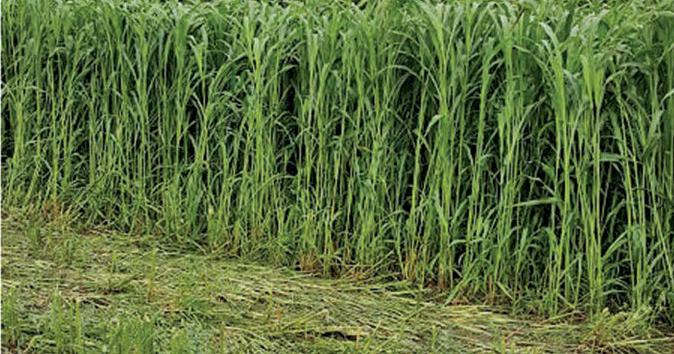
Fuhrer said, “This field of 3 pounds of flax, 10 pounds of oat and 18 pounds of rye was seeded at the same time as the soybean in alternating rows. Once the soybeans got to their proper stage, they were sprayed and the cover crop was taken out.”
A key benefit of the cover crop interseeding system was the ability of the fibrous roots of the oats and rye to build soil aggregates, which give structure to the plant. The aggregates build pore spaces for good water infiltration and air movement, while the flax creates mycorrhizae fungi which help scavenge for nutrients in the soil.
“Soybeans are not very capable of building soil aggregates. The soil aggregate is where the life is in the soil – where everything happens. This gives us an opportunity to grow, whether it is soybeans, flax, and broadleaves that aren’t going to build much of an aggregate, so we bring in the additional fibrous root and it is a game changer,” Fuhrer said.
Frasier said the field of soybeans looked “pretty dang nice.”
Frasier was one of two speakers invited to the special day to talk about his cropping experiences – the other was Pat Guptil, a well-known and respected cow/calf operator and grazing expert, who ranches near Quinn, S.D., and spoke on rotational grazing. Guptil is one of the instructors/experts for the North Dakota Grazing Lands Coalition grazing school to be held near Powers Lake Sept. 17-19.
As an agronomist at Independent Ag, cover crop coach, corn hybrid tester, and partner with his dad, Jayme, at Frasier Farms in South Dakota, Frasier raises no-till soybeans, corn and spring wheat, along with certain species of cover crops, on their regenerative row crop farm. Next year, they plan to switch out the spring wheat for another small grain, such as cereal oats or rye. Having diverse crops growing together is part of their soil health plan.
“I think the importance of having multiple species growing at the same time, even with a cash crop is really beneficial,” Frasier said.
On their farm, they grow their soybeans interseeded with a species of oats, rye and flax as the cover crop.
“We’re using an air seeder to plant it and that air seeder gives you two tanks. We have beans in one tank and they’re planted on 15-inch rows and then the cover crops in the other tank are planted in between them on 15 inch rows, too,” he said. “They are planted all in the same pass – different rows but the same pass.”
For six years, Frasier and his dad have been farming soybeans this way, and they are reaping the benefits of it. They don’t need to use many inputs because the covers suppress weeds and the tight flower sets create more yield.
“We’re spraying less often,” he said. Cutting down on herbicide is a major input they are able to save on soybeans that grow next to cover crops with fibrous roots.
Yields have risen on average over the six year production history, and that is partly because the roots are taking up more nutrients, and the tighter flowers are creating more yield, Frasier said.
“We’ve increased plant available nutrients. We’ve increased APH – average production history, which means increased yield. And we have done it on every soybean acre for six years now,” Frasier said.
The reason they raise their soybeans this way is because beans “like a little bit of competition and stress early in the season, and it changes their plant architecture a little bit. You can get more branching and the growth from the interseeded covers help to reduce weed pressure.”
They soil sample every year, and in the fall of 2025, that soil sample showed they had gone from 18 pounds of available phosphorus to 54 pounds of available phosphorus without applying fertility.
“What that did for us is we raised 72 bushels spring wheat on that field this year with a zero applied phosphorus. That’s not every single time, but that’s what the testing showed and I am a big believer in testing too – both tissue sampling and soil sampling,” he said. “Soil tests are just great little points along the road of going toward soil health.”
At the Menoken farm Alex Frasier bean field, SethBoechler, Menoken Farm manager said they have soil probes inserted in the soil that tell them how much moisture is in the field, along with other measurements.
“When you drive by our field, you are going to see flags. They indicate soil moisture probes that are 3 feet deep with a sensor located every 6 inches in the soil. In this field, the reading shows that we are now at 48 percent moisture,” Boechler said.
Frasier said he talked to a lot of farmers at Menoken Farm who expressed that their main concern every year was moisture, although the last few years have been wetter both in ND and where Frasier farms in South Dakota. These farmers were cautious about seeding a cover crop with the soybean because they thought it would take moisture away from the developing bean plant.
“Moisture is always a concern. Our average rainfall is 16 inches, although the last 5-10 years, we have been really wet. Obviously, rain makes grain,” Frasier said. “But people always come to me with the concern of using up moisture in the spring. When does a soybean need rain to make bushels? In those early fall months, so you are really not using moisture that is robbing from the soybean early in the season. You are actually helping avoid soybean seedling diseases, and soybeans do not like wet feet.”
In addition, with all the biology going on below ground with this type of system, farmers are actually creating moisture, he added.
Boechler said they while they don’t use fertilizer at the farm partly because of all the biological activity and release of nutrients going on in the Menoken farm fields, they do use a weed management strategy that includes herbicides. Kochia and pigweed are a couple of their main weeds. But to avoid resistance issues, they are using different modes of action with their herbicides.
“We are trying to use some different modes of action and just change things up a little bit,” he said.
Frasier added kochia thrives when there are excess nitrates in the field, but a cover like rye with fibrous roots can use up nitrates and suppress kochia.
“These small grains love nitrates in the growing season. You are not only controlling it through the root exudates with the rye, but using up nitrates, which is going to suppress weed growth. You are also taking that nitrate and making good use with a plant,” he said.
Frasier said some farmers apply herbicide in the fall “at light rates to control weeds” but it can also be done in the spring before kochia begins emerging.
“In 2016 on our farm, we had a half section of beans that we combined at like 1.5 mph because the kochia was so thick to now - where you can’t find a kochia plant on our farm,” he said. “The fall application gets you to your planting window in the spring and then the cover takes over from there as the weed suppression early in the spring - instead of using chemicals in the spring.”
Six years later, they still use herbicides on some of their acres but they also use a diverse weed management system.
“We are managing with chemical; we’re managing with residuals and burndown, but we’re also managing with plants. So, I’m trying to use everything I can to manage weeds (on his own farm) instead of just relying on one or two things,” Frasier said.
The longer producers grow their bean crop interseeding it with fibrous root crops like rye and oats, the more benefits they will see for the next crop and for future crops in the field, including weed suppression and increase in yields, he pointed out.
“As plants break down, they release nutrients back into the system, as well. All that biological activity creates moisture and the longer you do this (type of system) the more benefits you are going to see,” Frasier said.
Frasier also said problem areas like saline spots should be managed differently in the field - perhaps taken out of row crop production or treated with mulch - rather than being subjected to the same inputs as the rest of the field.
Also, at the Menoken Farm event, producers and others rode wagons to see a variety of crop rotations and perennials, including the open pollinated corn from last year that now belongs to the environment of the farm and the high tunnel gardens, as well as the outside gardens. In one of the fields, a 13-species full season cover crop was growing. It rotates with a cash crop for good water infiltration and good yields the second year. There was also a field of canola that was thriving and growing closer to harvest; the Rick Scott planting green soybean field; a GMO corn and alfalfa field; and a perennial field where sheep and cattle were grazing together.
Shadlynn Severance, an intern with Menoken Farm and Ducks Unlimited, who graduated from the Tribal College at New Town, is still working internships to find out more about starting and developing her own farm. She has four sisters at home, and they are all involved in different careers. She decided to go into agriculture after she took an ag class in seventh grade. She became fascinated with growing food and raising her own sheep herd, and she hasn’t changed her mind over the years.
She ended up raising a sheep herd, so she enjoys working with the sheep and cattle at Menoken Farm, saying it has been “a lot of fun.”
“Sheep and cattle graze at different levels, so more of the perennials and even weeds are eaten in the pasture,” Severance said. At Menoken Farm, they use a poly wire for rotational grazing.
Besides the grazing part, Severance enjoys the high tunnel garden.
“We don’t use fertilizer anywhere on the farm. Look how nice everything looks,” she said.
Be the first to know
Get local news delivered to your inbox!



.png)
