

.jpeg)
.png)
EFFINGHAM, Ill. — The southern Illinois edition of Beck’s Hybrids 2025 Becknology Days Aug. 8 in Effingham included several tours on topics from water management to spraying with drones.
Matt Montgomery, agronomy education lead, said crop production comes down to how the season starts, then maintaining yield potential and having a harvestable yield.
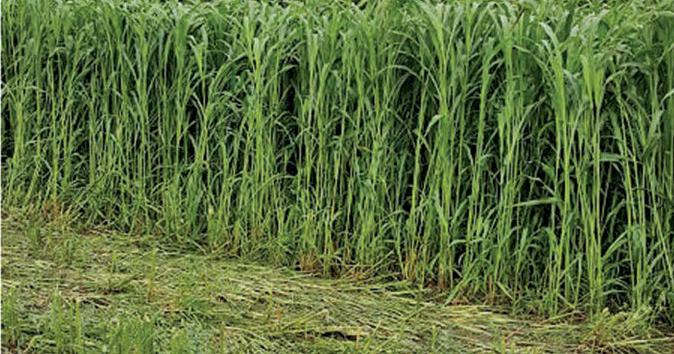
One of the tours focused on setting a corn planter correctly and managing corn residue without tillage.
Montgomery addressed the benefits to breaking down that residue.
“There are nutrients bound up in that residue, and if we break them up into those confetti-size pieces we will get that fertility back into the soil that much more quickly,” he said.
Breaking down residue
Tony Uthell, practical farm research technician, said his team has looked at several methods to manage residue. Farmers saw return on investment using a chopping corn head when they hit 305 acres, and 289 acres for a Yetter Stalk Devastator in a corn after corn study. Looking at soybeans after corn, Uthell said a chopper head paid off at 906 acres.
But chopping isn’t the only option, Montgomery said. The biological space adds “workers” to the situation by adding bacteria to chew up residue. However, their research shows biologicals for residue degradation has not paid off in southern Illinois plots.
Montgomery said the PFR team spends a lot of time trying to figure out how to make nitrogen dollars more efficient. He presented multilocation data with rates of 130 to 250. Montgomery said 160 units for a 236-bushel crop feels lower than some might expect. He said in southern Illinois data, 130-160 is where they see the highest ROI, which is 0.7 pounds of nitrogen per bushel.
“We encourage you to do some nitrogen studies year in and year out on your farm,” Montgomery said. “Figure out what you need to tweak your nitrogen rate down.”
In another nitrogen study, Uthell described treatment of 190 units of nitrogen applied with a control of 190 units of anhydrous with N-Serve. They then utilized three different application methods. The first was with a planter in a 2x2x2 situation. Then at V3, they put on the remaining 60 units using a sidedress bar. The final method was at V8 with wide bars on the sprayer.
Uthell said the fall anhydrous followed by 60 units on with the planter was the method that won out in southern Illinois. This was the first year gathering data with the second-year data currently in the ground.
Uthell said the most important thing farmers can do when running a planter is getting out in the field and looking around.
Water management
Another riding tour addressing water management capped off 10 years of research and shared the best investment for tile spacing and depth, sub-irrigation and drip irrigation.
Alex Long, field agronomist, said irrigation and tile has been on the Effingham farm for 10 years. The farm has a block that is control, another has contour tile, another block has drip irrigation, one with 30-foot pattern tile with drip irrigation and another with 30-foot pattern tile. They have bean and corn data for every year.
The areas that have contour or tile also have gates they can use to flood the tiles with water in the summertime from below.
Long said the way they get rid of water is through surface drainage or evaporation. A 2-foot depth on clay-type soils with 30-foot spacing is going to maximize the response but minimize the cost, he said.
Long said that the 30-foot tile plus drip irrigation gives the best yield, but he believes what is carrying the yield is drip irrigation.
“When we can irrigate with that tile we see the different steps there,” Long said.
He said they also have some sensor-based sub-irrigation that gauges how quickly moisture level is rising or falling before irrigating.
Field agronomist Drew Beckman said soybeans show stress more later in the season. Beckman said with contour tile, they saw a 5.1-bushel yield increase. They saw a 5.6-bushel increase with the drip irrigation alone, 5-bushel increase to the 30-foot tile drainage with drip irrigation and only 1.5 bushels for the 30-foot tile drainage.
Be the first to know
Get local news delivered to your inbox!


.png)
