

.jpeg)
.png)
Container-grown fodder won't replace hay fields, but when evaluated on a dry matter basis, it can make economic sense where water, freight, and feed security matter most. Illustration generated with AI. by Niko Simos It's late June and Maria is doing the math no rancher wants to do twice. Her pasture in northern Chihuahua is browning early, the alfalfa she trucks in has jumped in price again, and the well is lower than it was this time last year. Then a sales rep sends her a video: a 40-foot shipping container, stacked floor to ceiling with vivid green barley sprouts, churning out fresh fodder every single day on almost no water. "Drought-proof feed," the caption says. "Grow your own." Maria wants to believe it. Should she? This is the question we get at Agritecture almost every week, from ranchers, dairies, feedlots, and the investors backing them. So we did what a good advisor should: we set the marketing aside and ran the numbers the way they actually need to be run, not per kilogram of green sprout, but per ton of dry matter delivered to the animal. The answer is more interesting than either the hype or the eye-rolling. Container fodder is genuinely useful. It's just useful for a different reason than the brochure claims. The Americas feed their livestock on an almost unimaginable volume of forage. In 2025 the United States alone produced about 123 million tons of dry hay, including 50.2 million tons of alfalfa, plus 124 million tons of corn silage (Ag Proud / Progressive Forage, 2026). That feed base supports 86.2 million head of cattle as of January 2026 (USDA NASS). Mexico is among the world's largest alfalfa producers, with Chihuahua consistently leading national output by value. Now hold that next to what a container produces. A container-scale fodder production unit running every day produces around 850 pounds of fresh fodder daily, roughly 150 tonnes of fresh fodder a year (The Fence Post, 2024). Because barley sprouts are only about 12 to 15% dry matter, that fresh weight converts to roughly 20 to 22 tonnes of actual dry matter (Feedipedia). You could deploy thousands of these across the hemisphere and still supply well under one percent of the region's roughage. That's not a flaw in the machine. It's a law of acreage: bulk forage will always be grown in fields, because nothing else scales to feed hundreds of millions of cattle. So if Maria is dreaming of replacing her hay supply with containers, the math says no before it says anything else. Here's the part the glossy video skips. A barley sprout grown over six to eight days actually loses dry matter compared to the original seed. During sprouting, enzymes convert stored starch into simple sugars, which are burned for energy and released as CO2 and water, a net loss of 7 to 47% of the original dry matter (Feedipedia). Photosynthesis cannot compensate: sprouts are harvested before the plant reaches a positive net photosynthesis, which doesn't occur until four to six inches of leaf growth (Progressive Cattle, 2022). So a system that looks wildly productive by the bucketful is far less impressive once you weigh what the animal actually digests. Convert everything to dollars per ton of dry matter, and the picture snaps into focus. Open-field corn silage runs about $136 to $151 per ton of dry matter, based on University of Missouri Extension budgets. The American Farm Bureau Federation pegs full economic alfalfa costs anywhere from $165 to over $300 a ton. Hydroponic fodder? Several times that. Extension analysis puts hydroponic fodder at roughly $0.40 per pound of dry matter — about $880 per metric ton — compared to $0.11 per pound for good-quality hay (Tranel, Iowa State University, 2013). A Utah State University study found hydroponic barley fodder cost 13.4 times as much per kilogram as conventionally grown barley on a dry matter basis (Johnson, Utah State University, 2025). The honest range for container fodder lands somewhere around $400 to $1,200 per ton of dry matter. The exact number shifts with seed, labor, and financing, but field-grown forage wins on cost, every time. And notice what drives that cost. It isn't electricity, despite what the 'low energy' pitch implies. Seed alone can consume 85 to 90% of production cost in simpler systems (Feedipedia), and labor requirements of one to four hours daily add substantially to costs in any system (University of Vermont Extension, 2016). Cheap power doesn't save you here. You're essentially repackaging seed into a wetter, more expensive form. This is where the cynics get it wrong. The fair comparison for Maria isn't farm-gate silage in Iowa, that feed doesn't exist on her ranch at that price. Her real alternative is delivered hay during a drought, trucked in at a premium, when she can find it at all. Against that benchmark, a container starts to make sense. Hydroponic systems use roughly 1.5 to 2 litres of water per kilogram of fresh fodder, versus cited field figures around 73 L/kg for barley fodder and 85 L/kg for alfalfa (Feedipedia). In a water-stressed place, that gap is real money. And drought is exactly Maria's problem: as of late June 2026, 50% of U.S. alfalfa hay acreage and 50% of the national cattle inventory were within drought areas, per the USDA Drought Monitor. So container fodder earns its keep in specific places: water-scarce zones like the U.S. Southwest and northern Mexico; remote operations paying brutal freight on every bale; biosecure feedlots and calf units that can't risk a broken feed chain; and specialty dairies that want fresh green feed year-round (Agritecture analysis). In those settings, a container can beat the cost of emergency or premium roughage, even though it never beats field-grown forage at the farm gate. That distinction is the whole investment case. Treat a container fodder system as a resilience and logistics tool, not a replacement for hay and silage. Underwrite it against your worst feed week of the year, the drought, the freight spike, the supply shock, and it can pencil out beautifully. Underwrite it as your everyday feed source and it almost always disappoints. The catch is that the answer genuinely depends on your numbers: your water cost, your delivered-hay price, your labor model, your financing, and the dry-matter content you can realistically hit at feeding. Those variables swing the verdict from "obvious yes" to "hard no." There's one rule we never let a client skip, restate every comparison in dollars per ton of dry matter delivered to the feed bunk. That single move clears away almost all the misleading math in this market. Maria's instinct wasn't wrong. She just needed someone to tell her which problem the container actually solves, and to run her real numbers before a salesperson ran them for her. Weighing a container or controlled-environment fodder investment?→ Book a discovery call before you sign anything. We'll model your economics on a dry-matter basis, pressure-test the vendor claims, and tell you honestly whether your site is one of the places this technology pays off, or one where you're better served by the field. You'll walk away with the real math either way.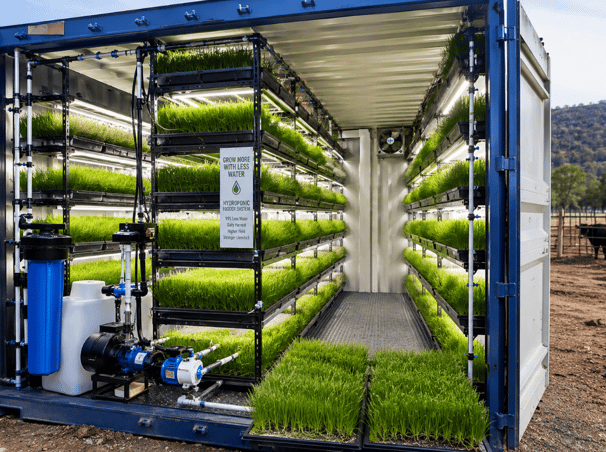
First, a reality check on scale
The trick hiding inside "fresh weight"
.png?width=1280&height=200&name=Blog%20CTA%20Banners%20(9).png)
So why would anyone buy one?
What we'd tell Maria - and what we'd tell you




.png)
