

.jpeg)
.png)
Program helps protect ranches when Mother Nature cuts hay, grazing output
Mother Nature always has the last say on the quality and quantity of a hay crop and resulting feed capacity. When she shuts off the moisture, producers and their herds suffer. That’s when the U.S. Department of Agriculture’s Risk Management Agency (USDA-RMA) Pasture, Rangeland, Forage (PRF) insurance program from ProAg steps in.
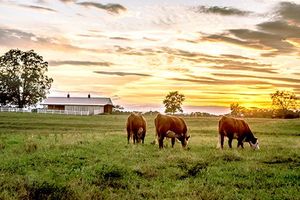
The PRF program is available in two-month increments and designed primarily for cattle producers who raise their own feed crops, namely pasture, alfalfa and other forage crops. When hit hard by a sharp moisture deficit, producers have a range of PRF coverage options that help make up for a large share of the expense required to preserve feed capacity and replenish forage feedstocks. Policyholders can select a coverage level from 70% to 90% in 5% increments and USDA-RMA does provide a premium subsidy. CAT coverage is not available.
How Pasture, Rangeland, Forage protection works
The Pasture, Rangeland, and Forage insurance program was designed to help protect a producer’s operation from the risks of forage loss due to the lack of precipitation. The insurance coverage is for a single peril – lack of precipitation. It is not based on individual farms or ranches or specific weather stations. Producers do not have to insure all of their acres; however, producers cannot insure more than their total number of insurable acres.
Applied to both grazing and haying ground, producers can opt for different coverage levels, index intervals, or productivity factors, with the ultimate goal of providing the ability to make up for at least a share of precipitation deficit losses. Producers select a productivity factor to match the amount of protection to the value that best represents their operation and the productive capacity of the producer’s acres.
A grid system based on 0.25-degree increments in latitude and longitude — equal to approximately 17 square miles — is the basis for the rainfall data that ultimately dictates whether conditions justify a PRF payment. Acres will be assigned to one or more grids based on the location to be insured. A producer must select at least two, 2-month periods where precipitation is most critical to their operation. These periods are called index intervals. (See your actuarial documents to determine the minimum reporting periods required for your area.)
Rainfall data for PRF coverage timeframes is compared to historical data to determine whether payments are justified. A rainfall index (RI) based on National Oceanic and Atmospheric Administration (NOAA) National Centers for Environmental Information (NCEI) data determines whether the program pays claims. Due to a change in the data source for RY2027, rates, historical illustrations and payment patterns may differ from prior-year results.
There’s one big caveat with the grid structure for PRF policies; while it is more pixelated than a county-level basis, there is still a risk. “The grid is a representation of a very large area. I always tell growers to keep in mind they may not get a drop of rain on their land, but that grid may have been enough to push you out of a payment,” said ProAg Senior District Sales Manager Michelle Tobias. “Over the course of several years, it should average out, but it’s important to be aware that these are things that can happen. We’re not creating a rainfall index for a specific farm.”
A needed boost in tough times
For many PRF policyholders, the program is more than just insurance. It’s a risk management tool that can enhance a producer’s ability to sustain his or her herd, even in the face of weather challenges that might otherwise necessitate herd liquidation just to make ends meet, according to ProAg Regional Vice President Whitney Redig.
“It’s a tool to give producers a little protection, knowing they only have so much capacity on their acres. If it gets dry, instead of selling off animals because they don’t have the grass or hay to sustain them, PRF will give them an avenue to enable them to buy hay,” says Tobias, who works with customers around the Midwest and northern Plains. “If the rain turns off for you and you have to supplement hay for your herd, it’s going to ease the financial burden somewhat, but not give you enough to offset the total cost. It will take some of that weight off of having to go out and buy on the open market.”
Learn about the factors you should consider when selecting PRF by talking to your trusted ProAg crop insurance agent. Interested in adding PRF coverage to your operation? Start here to view ProAg resources or if you’d like to run the numbers, find your local ProAg agent here.
Editor’s Note: This is the first of two articles on the Pasture, Rangeland, Forage program. See part two here.



.png)
